
Illinois Realtors® released its August housing data today, revealing higher prices, lower inventory and decreased activity as the summer selling season comes to a close. Also, the Institute for Housing Studies at DePaul University provided its predictions for both prices and activity through November of this year. Let’s dig into the numbers to better understand what this means for you.
Sales Activity
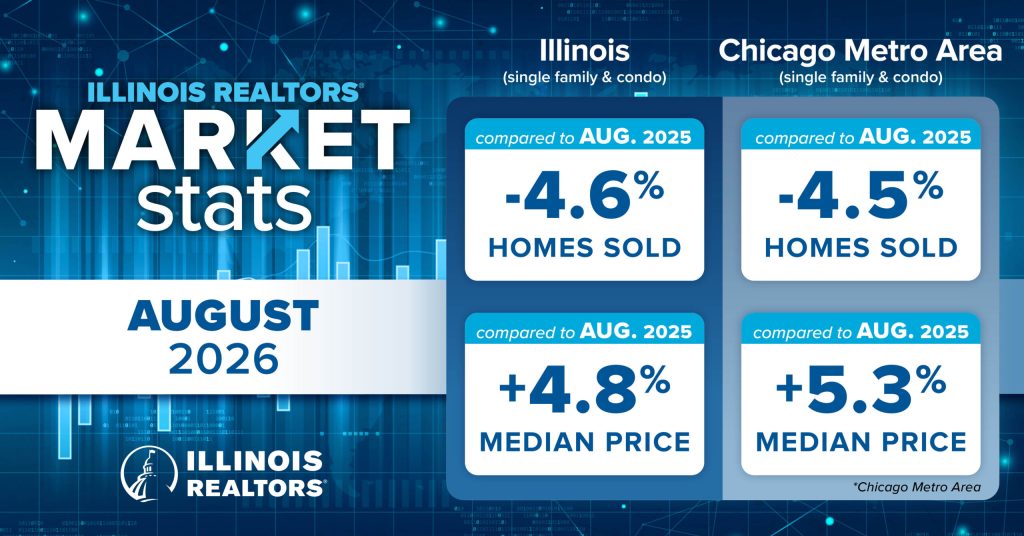
When examining overall activity in August, closed sales trended lower. August statewide sales decreased 4.6% over last year’s numbers. However, they were up 1.6% compared to July. Sales in the Chicago metro area were down by almost the same percentage, while activity in the city of Chicago decreased by a smaller amount, just 2.7%. In terms of closed condo sales in Chicago, the Institute for Housing Studies reported that this activity fell by about 1.4% compared to the previous August.
This lowered rate of activity may be due to higher interest rates, with Freddie Mac reporting the monthly average commitment rate for a 30-year, fixed-rate mortgage at 7.03% as of today, up from 6.59% last August. And these rates are not expected to decrease anytime soon, as the Federal Reserve increased rates for the first time in years earlier this month.
When it comes to foreclosure activity, IHS reported these levels were slightly above last year in the Chicago metro area but remain below pre-pandemic levels. However, they noted that nationwide foreclosure activity was up 10% from a year earlier as of this past July.
Supply & Demand
Inventory trended lower in August with available homes for sale statewide down 4.7% over last year. In Chicago, that decrease was even more striking, down 11% in the metro area and 23.3% in Chicago proper. Inventory for condos saw a much deeper decline of about 19% compared to August 2025, according to the Institute for Housing Studies. Despite these lower levels of supply, the average home spent about one extra day on the market before selling, both statewide and in Chicagoland.
IHS noted that Illinois has displayed one of the country’s weakest recoveries to pre-pandemic inventory levels. Highlighting that we’ve seen the second-lowest level of new housing construction per capita of any state, they note this ongoing inventory shortage “suggests that the market will remain highly competitive and challenging for homebuyers throughout the near future.”
Prices
Partially due to this constrained inventory, home prices continued to shift upward. In Chicago, the median home price was 8% higher than last year, settling in at $405,000 in August. Outside of the city, prices rose by less: Statewide they were up 4.8% to $330,000 while Chicagoland saw an increase of 5.3% to $395,000. IHS found that prices for condos and townhomes in the city of Chicago rose 8.2% over last year.
Even with increases in mortgage rates and prices, Illinois Realtors® noted that the Housing Affordability Index increased slightly over last month, indicating the continuation of a slow shift toward a buyer’s market. And thanks to a flat national unemployment rate and a measurable decrease in joblessness in Illinois, August employment gains exceeded expectations.
The Forecast
Despite the rise in the affordability index, the Institute for Housing Studies estimated that the rising rate of inflation combined with decreases in consumer sentiment will translate to “modestly worse” affordability conditions for single-family homebuyers compared to this time last year.
While IHS expects activity to follow its seasonal pattern and decrease over the coming months, they also expect home prices statewide to show 7% year-over-year growth through November. In a departure from the statewide projection, IHS predicts that city prices will actually fall by almost 3% between August and November, though they’ll still be measurably higher than last year. They estimate condo prices will rise about 2% between August and November, resulting in prices that are about 9.2% higher than the same time in 2025.
IHS’s forecast shows total sales activity between September and November falling 7.4% below this same period last year. In the city of Chicago, they also project activity will decrease, but by a bit less — about 5% lower than 2025. They estimate total condominium sales activity in Chicago will be almost 10% lower than last year.

Sarah Ware is the founder and principal and managing broker of Ware Realty Group.